The Business World Has Changed. Have You?
Why Australian business owners need to build their capabilities before rising pressure starts costing them more than money.
There was probably a time when running your business felt more manageable.
You understood your market. You knew your numbers. You had a good handle on your team, your customers and the decisions you needed to make.
You were busy, but you felt in control.
Now think about what’s changed.
Operating costs have climbed. Margins are under pressure. Customers are becoming more cautious. Finding and retaining the right people remains a challenge in many industries. And the economic environment seems to shift just when you’ve started finding your feet.
The question isn’t whether you know how to run your business. It’s whether the skills, strategies and systems that got you here are enough to take you forward.
Understanding Flow: When Challenge Meets Capability
Psychologist Mihaly Csikszentmihalyi developed the concept of flow, a state of deep focus and engagement that occurs when our skills are appropriately matched to the challenges we’re facing.
When the challenge is too low for our capabilities, we can become bored or disengaged.
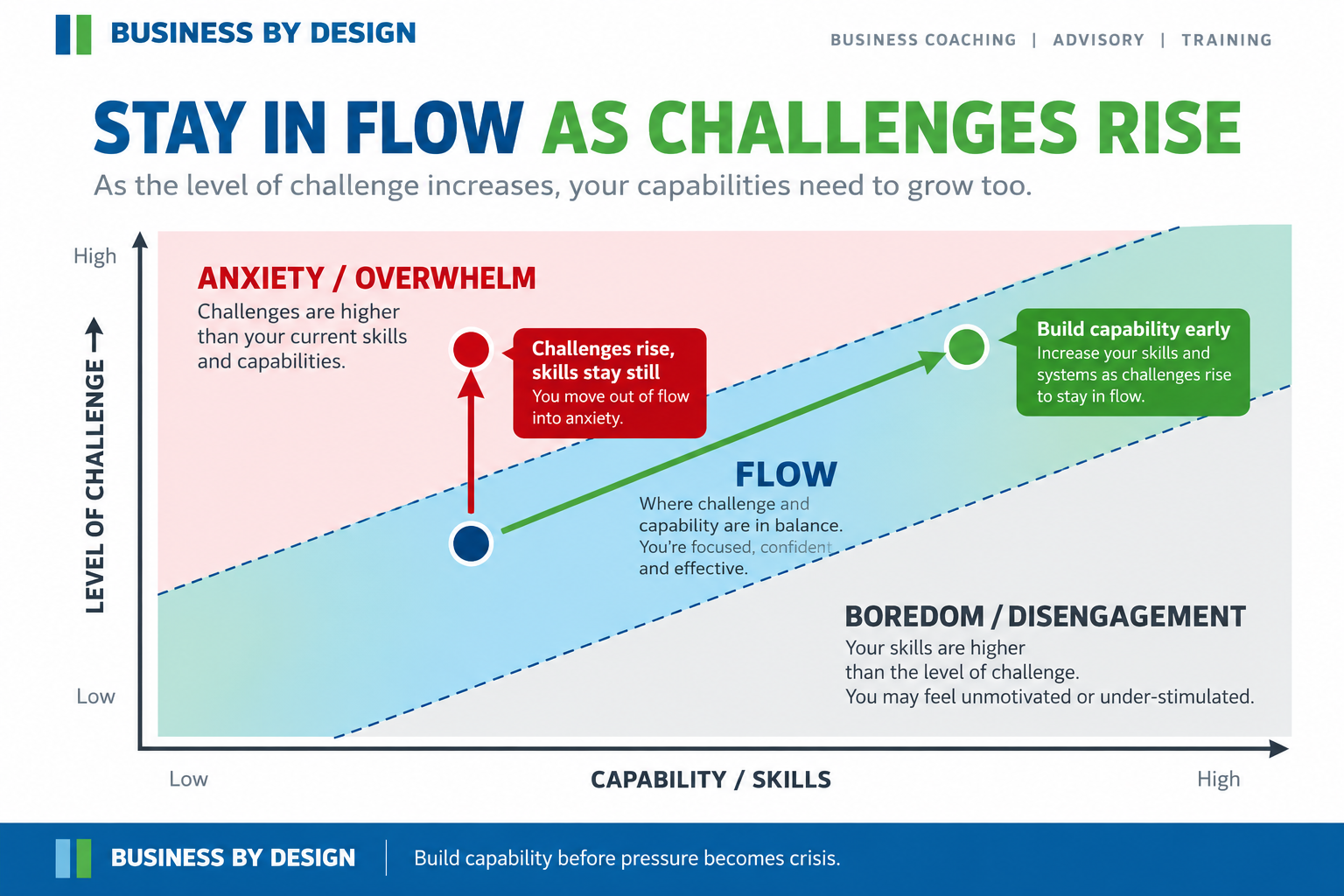
When the challenge is too high for our current capabilities, anxiety and overwhelm can take over.
But when challenge and capability are appropriately balanced, we create the conditions to perform at our best.
This principle is highly relevant to business leadership.
When you have the skills, knowledge and experience to handle the challenges in front of you, you can make decisions with greater confidence and clarity.
But what happens when those challenges increase and your capabilities stay the same?
You risk being pushed out of your flow state, not because you’ve become a less capable business owner, but because the demands of running your business have changed.
The Australian Business Environment Is Changing. Are You Keeping Up?
Australian businesses are operating in an environment where economic pressure and uncertainty are creating new challenges for owners and leadership teams.
And the latest figures demonstrate just how significant some of these pressures have become.
According to the Australian Bureau of Statistics, annual consumer price inflation reached 4.3% in September 2026, up from 4.0% in August.
The Reserve Bank of Australia increased the cash rate target to 4.60% in September 2026, reflecting ongoing concerns about inflation and cost pressures.
Meanwhile, NAB’s September 2026 Monthly Business Survey reported business confidence had fallen to -13 index points, its third consecutive monthly decline.
NAB’s September-quarter survey also revealed that businesses were experiencing renewed pressure on profit margins. Purchase costs increased by 1.2% during the quarter, while final product prices increased by just 0.5%.
For business owners, that difference matters.
It means the cost of delivering products and services may be increasing faster than the prices customers are prepared to pay.
And that’s only part of the picture.
Many businesses are also managing:
- Rising operating costs: Energy, fuel, materials, insurance, wages and other overheads can erode profitability.
- Higher financing costs: Interest rates and borrowing conditions influence cash flow, investment and growth decisions.
- Changing customer behaviour: Economic uncertainty can lead customers to delay purchases, negotiate harder or reconsider spending.
- Workforce challenges: Finding, retaining and developing capable employees remains difficult in some industries and regions.
- Rapid technological change: AI, automation and new systems are changing how businesses compete and operate.
- A VUCA environment: Volatility, uncertainty, complexity and ambiguity make long-term decisions more difficult.
Not every business is experiencing these pressures in the same way. But for many owners, several challenges are arriving at once.
And when the level of challenge increases, the capability required to manage it must increase too.
Are You Being Pushed Out of Your Flow State?
- The warning signs aren’t always dramatic.
- Sometimes they appear gradually.
- You’re working longer hours but making less progress.
- Revenue might be holding steady, but profitability is slipping.
- Cash flow is becoming harder to predict.
- You’re spending more time solving immediate problems than planning for the future.
- Your team is increasingly dependent on you to make decisions.
- You’re reacting to what’s happening around you rather than confidently directing where your business is going.
- Sound familiar?
Many business owners respond by doing what they’ve always done.
They work harder. They put in more hours. They try to solve every problem themselves.
But here’s the uncomfortable reality.
Working harder with the same capabilities won’t necessarily solve a problem that requires a different level of thinking.
You might need better financial information, stronger leadership, improved systems, a different business strategy or experienced advice to help you see opportunities you haven’t considered.
The challenge isn’t simply to do more. It’s to become better equipped to manage what’s changing.
You Have a Choice: React to the Pressure or Build the Capability to Manage It
When the challenges facing your business increase, you have several options.
You can reduce unnecessary complexity, change your operating model, improve pricing, rethink your market or adjust your growth ambitions.
But to make those decisions well, you need the right capabilities.
That might mean:
- Stronger financial management: Understanding your margins, cash flow, working capital and the financial drivers of your business.
- Better strategic planning: Identifying emerging risks and opportunities before they become urgent.
- Improved leadership: Developing your people, delegating effectively and building a team that can perform without constant intervention.
- More effective systems: Reducing inefficiencies, improving accountability and creating a business that is less dependent on its owner.
- Greater adaptability: Making informed decisions when circumstances change rather than relying on yesterday’s assumptions.
The right priorities will be different for every business.
But the principle remains the same.
As the level of challenge rises, your capabilities need to rise with it.
Why Waiting Until You’re Under Pressure Can Be a Costly Mistake
One of the biggest mistakes a business owner can make is waiting until a problem becomes urgent before seeking advice.
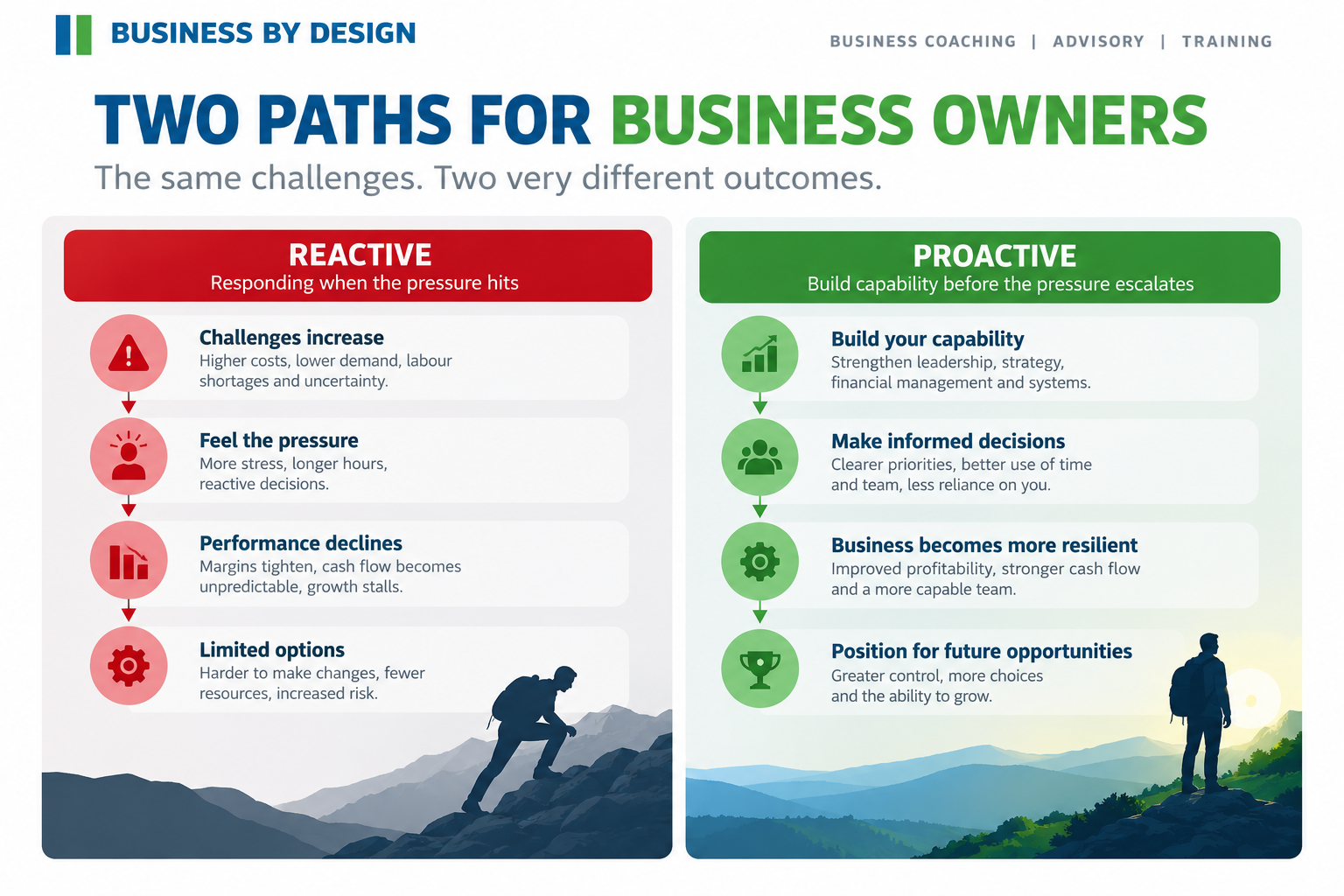
By then, cash flow may already be under pressure. Margins may have deteriorated. Key employees may be disengaged. And the time and resources available to make meaningful changes may be limited.
Now compare that with an owner who recognises the warning signs early. They review their financial performance. They seek experienced advice. They invest in developing their leadership skills. They strengthen their systems and improve how their team operates. They prepare for the challenges ahead while they still have the time, resources and flexibility to make considered decisions.
Both businesses may face similar external pressures.
But one is reacting to change. The other is building the capability to manage it.
That’s a significant difference. Business coaching, strategic advice and leadership development shouldn’t be viewed only as solutions when something goes wrong.
They can be proactive investments in the future performance and resilience of your business.
Before You Do Anything Else, Take a Clear Look at Your Business
You don’t need to solve every challenge today. But you do need to understand where your business is most exposed.
Start by asking yourself:
- Do I have a clear understanding of my cash flow and profitability over the next three months?
- Which external pressures could have the greatest impact on my business?
- Are my current systems and people capable of supporting the business through change?
- Am I spending enough time working on the future of the business rather than managing daily problems?
- What skills, knowledge or advice would help me make better decisions over the next 12 months?
If you’re unsure about the answers, that’s a useful place to start.
Free Resource: From Pressure to Plan
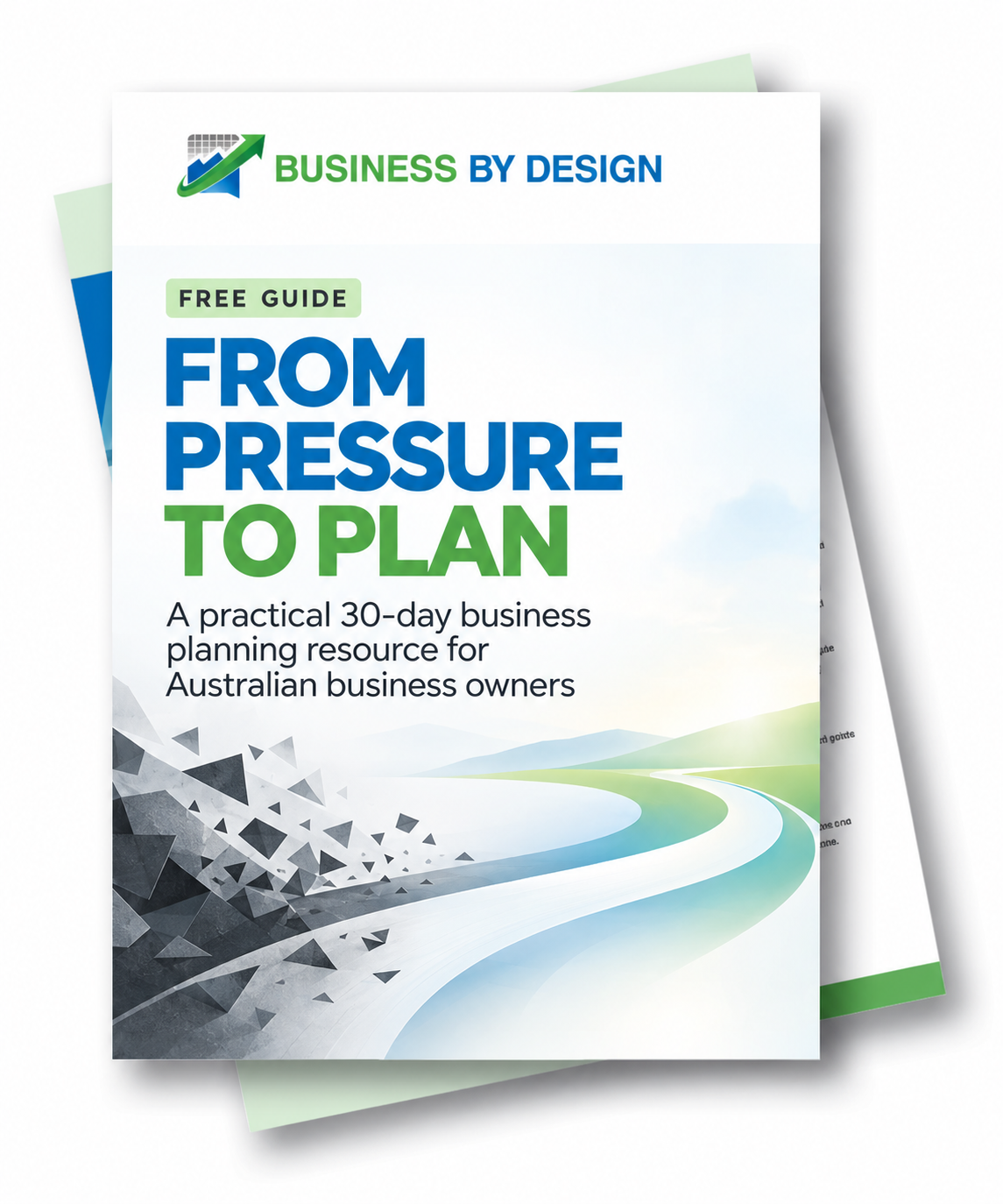 A practical 30-day reset for Australian business owners navigating uncertainty.
We’ve developed a free guide to help you step away from the day-to-day pressure and take a clearer look at what’s happening in your business.
From Pressure to Plan is designed to help you:
- Identify where external challenges are affecting your business.
- Review your cash flow, profitability and operating pressures.
- Assess the areas that need attention.
- Create a practical four-week action plan.
- Establish a simple weekly review to keep your business moving forward.
You don’t need a perfect forecast or a complicated strategic plan to begin. You need clarity about what’s happening, what matters most and what to do next.
[DOWNLOAD YOUR FREE 30-DAY BUSINESS RESET GUIDE]
Free practical guide from Business By Design. Enter your details to receive your copy.
The Best Time to Build Capability Is Before You Need It
Here’s a question worth considering.
If the challenges facing your business increase over the next 12 months, are you confident your current skills, systems and leadership capabilities will be enough?
Or are there gaps you’ve been meaning to address but haven’t quite found the time?
Because the greatest risk may not be the challenges themselves.
It may be waiting too long to develop the capabilities needed to respond to them.
The businesses best positioned to navigate uncertainty aren’t necessarily the ones with the fewest challenges.
They’re often the ones with the leadership, systems, financial visibility and strategic capability to respond effectively.
And those capabilities take time to build.
How Business By Design Can Help
At Business By Design, we’ve been working with Australian business owners since 1993, helping them develop stronger businesses through practical advice, coaching and leadership development.
Sean Martyn understands that running a business is very different from simply understanding business theory.
Through personalised business coaching, strategic planning, leadership development and practical business advice, Sean works with owners and leadership teams to identify opportunities for improvement and develop the capabilities needed to achieve their goals.
That may involve improving profitability, strengthening leadership, developing your people, building more effective systems or creating a clearer strategy for the future.
The goal isn’t simply to help you survive another challenging year.
It’s to help you build a business that performs better, is more resilient and gives you greater control over your future.
Don’t Wait Until the Pressure Makes the Decision for You.
The challenges are changing.
Is your business changing with them?
If you’re ready to strengthen your business and prepare for what’s ahead, now is the time to start the conversation.
Call Business By Design on (02) 6658 0775, email connect@bizbydesign.com.au, or get in touch with our team to explore how we can help.
Frequently Asked Questions
What is flow state in business leadership?
Flow is a psychological state of deep focus and engagement that can occur when the challenge of a task is appropriately matched to a person’s skills.
For business owners, the concept provides a useful way to understand why increasing business complexity may require stronger leadership, decision-making and management capabilities.
Flow is not a guarantee of success, but the model highlights the importance of developing skills as challenges increase.
How do I know if my business has outgrown my current capabilities?
Common warning signs include declining profitability, unpredictable cash flow, increasing owner workload, difficulty delegating, recurring operational problems and spending more time reacting to issues than planning ahead.
These problems can have several causes, but they may indicate that your business needs stronger systems, leadership or management capabilities.
What are the biggest challenges facing Australian small businesses in 2026?
Challenges vary by industry and region, but current pressures include inflation, financing costs, margin compression, changing customer demand, workforce capability, energy and operating expenses, and economic uncertainty.
The most useful starting point is to identify which pressures are affecting your own customers, cash flow, margins and business capacity.
When should a small business owner consider business coaching?
Business coaching can be valuable before a business reaches a crisis.
Owners may benefit when they are preparing for growth, experiencing increasing complexity, developing a leadership team, reviewing profitability, planning succession or seeking to reduce their involvement in daily operations.
Getting advice early can provide more time to evaluate options and implement changes.
How can business coaching help during economic uncertainty?
Business coaching can help owners strengthen strategic planning, leadership, financial visibility, accountability and decision-making.
An experienced coach can also provide an external perspective, challenge assumptions and help owners establish priorities.
The aim is to help business owners make informed decisions and build the capabilities needed to respond to change.
How can I make my business more resilient?
Start by understanding your financial position, protecting profitable customers and services, reviewing key operational risks, developing your team and reducing unnecessary reliance on the owner.
Regularly reviewing a small number of meaningful business indicators can help you identify problems earlier and adapt your plans.
What is the first step I should take?
Begin with a practical review of where pressure is affecting your business.
Our free From Pressure to Plan guide provides a 30-day framework to help you assess your position, prioritise actions and create a manageable plan.
[GET YOUR FREE 30-DAY BUSINESS RESET GUIDE]
Economic data referenced in this article was current at 29 October 2026. Sources: Australian Bureau of Statistics (September 2026 Consumer Price Index and Labour Force releases), Reserve Bank of Australia (29 September 2026 monetary policy decision), and NAB (September 2026 Monthly and Q3 Quarterly Business Surveys). National statistics are indicators of economic conditions and do not represent the circumstances of every individual business.