1 July 2026: What every Australian Business Owner must know
The start of a new financial year is never just an accounting reset. Each 1 July, a wave of regulatory, structural, and employment law changes reshapes what it costs — and what it takes — to run a business in Australia. This year, the changes are bigger than usual, and they touch nearly every aspect of your operations.
People & HR
The HR changes are real, but they’re just the start
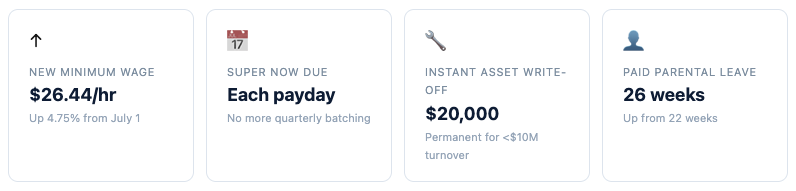
Wages are going up. The National Minimum Wage rises by 4.75% to $26.44 per hour from the first full pay period in July, and award wages move by the same amount. If you have staff on modern awards, now is the time to check your payroll is updated before you process your next run.
Paid Parental Leave extends to 26 weeks, government-funded, but your business carries the operational weight of managing longer absences. And from 1 July, Payday Super kicks in as law: superannuation must reach your employees’ funds within seven business days of every pay run, not quarterly. The Small Business Superannuation Clearing House also closes permanently on 1 July, if you’ve been using it, you need an alternative right now.
| What this means for you: Higher wage costs, tighter super deadlines, and the need to revisit leave management planning. These aren’t optional, penalties apply for non-compliance with both super timing and wage rates. |
Regulatory & Compliance
The structural changes are where most businesses get caught out
Beyond the headline HR numbers, 1 July 2026 brings a raft of regulatory and structural changes that many business owners haven’t fully mapped. This is where the real complexity, and the real risk, lies.
| ● | Anti-Money Laundering [NEW OBLIGATION]
AML/CTF Tranche 2 reforms expand to new sectors. For the first time, accountants, lawyers, real estate agents, and other professional service providers must enrol with AUSTRAC and meet Know Your Customer (KYC) obligations — verifying client identities, maintaining records, and reporting certain transactions. Financial crime costs Australia up to $82 billion a year; these reforms close long-standing gaps. If your profession is newly captured, non-compliance carries serious penalties. |
| ● | ASIC fees [COST INCREASE]
Business name and company registration fees rise with CPI. Registering a company increases from $611 to $636. Annual review fees for proprietary companies move from $329 to $342. Small individually, but another line of cost pressure for multi-entity structures. |
| ● | Tax position [OPPORTUNITY]
Loss carry-back returns. Eligible companies that make a loss in FY2027 can use it to claim a refund against tax paid in the previous two income years. Combined with the permanent $20,000 instant asset write-off for businesses under $10M turnover, there are real planning opportunities here — but only if you structure proactively rather than reactively at tax time. |
| ● | SMS communications [COMPLIANCE]
A new SMS Sender ID Register arrives 1 July. If your business sends branded text messages to customers — appointment reminders, promotions, alerts — you need to be registered through your telco or messaging provider to stay compliant and keep your messages trusted. |
| ● | Waste & environment [NSW MANDATE]
FOGO (Food Organics and Garden Organics) separation begins. Commercial food businesses in NSW — cafés, restaurants, caterers, aged care, schools — must transition to separate food waste collection. Initial costs may rise, but businesses that adapt early often reduce overall waste volume and bills over time. |
| ● | ATO compliance [INCREASED SCRUTINY]
The ATO is using payroll and reporting data more actively. With Payday Super creating a real-time data trail, non-compliance will surface faster. The ATO has indicated a measured first-year approach for employers making a genuine effort — but it is not a grace period for inaction. |
Yes, costs are rising. That’s exactly why now is the time.
It sounds counterintuitive, when costs go up, coaching feels like the first thing to cut. But the businesses that come out ahead after regulatory shifts are the ones that planned for them, not the ones that reacted to them. A business coach doesn’t just help you survive change. They help you turn it into an advantage your competitors miss.
Sean from Business by Design has worked across multiple businesses, different industries, different sizes, different challenges, and that breadth of experience is the asset you’re buying into. When you’re navigating AML compliance for the first time, restructuring your payroll for payday super, reviewing your entity structure for loss carry-back eligibility, or simply working out what all of this costs your business, Sean has seen it before. He’s helped others through it. And he knows where the leverage points are.
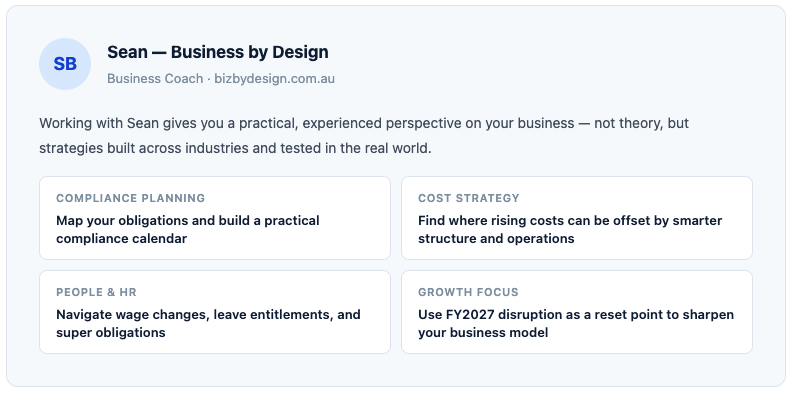
The businesses Sean coaches don’t just absorb change — they use it. When your competitors are scrambling to understand AML obligations or reconfiguring payroll systems on the fly, you’ll already be three steps ahead. That’s the value of experience applied before the pressure hits, not after.
Ready to make FY2027 work for your business? |