Succession can destroy your Business Wealth
A thriving business may be one of Australia’s most valuable private assets. It can also be badly damaged when leadership, ownership and control change without a plan. Privately owned and family-controlled businesses hold substantial wealth beyond superannuation and housing. They employ millions and underpin regional economies. So succession is not only a family matter; it affects staff, customers, suppliers and communities.
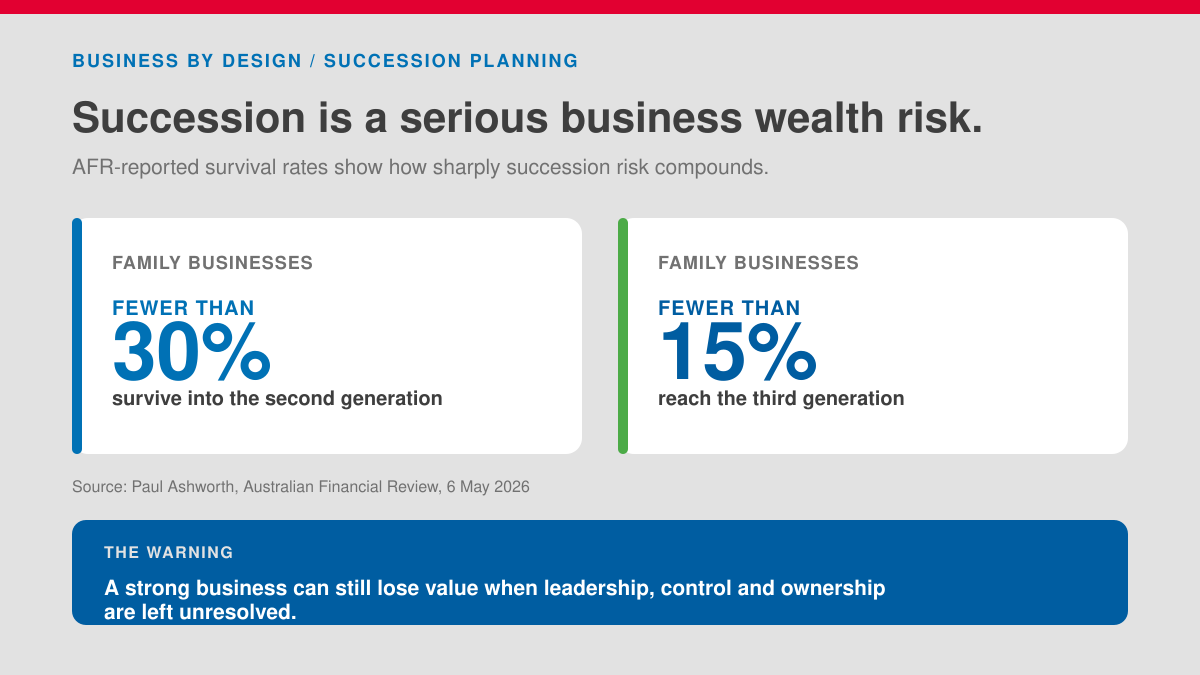
In a May 2026 Australian Financial Review article, wealth management specialist Paul Ashworth reports that fewer than 30% of family businesses survive into the second generation and fewer than 15% reach the third. He argues that many failures are not caused by poor assets or weak markets. Instead, they follow delayed planning, unclear governance, misaligned incentives and people issues that owners could address earlier.
Six traps that can undermine succession
The article highlights six risks for business owners:
- Treating succession as a tax or valuation exercise before clarifying the owner’s goals.
- Avoiding hard conversations until illness, fatigue or conflict forces decisions.
- Assuming family wealth means the next generation is ready to lead.
- Relying on informal governance, with unclear authority and incentives.
- Treating succession as a single transaction instead of a staged process.
- Assuming the family must keep operating the business.
Together, these traps show why succession cannot be reduced to tax advice or sale documents. If the owner is not ready to share decisions, or people cannot agree on who should lead, technical work alone will not resolve the problem. Control can become stuck, wealth can remain tied up and relationships can fracture.
Start with the owner, then build a plan
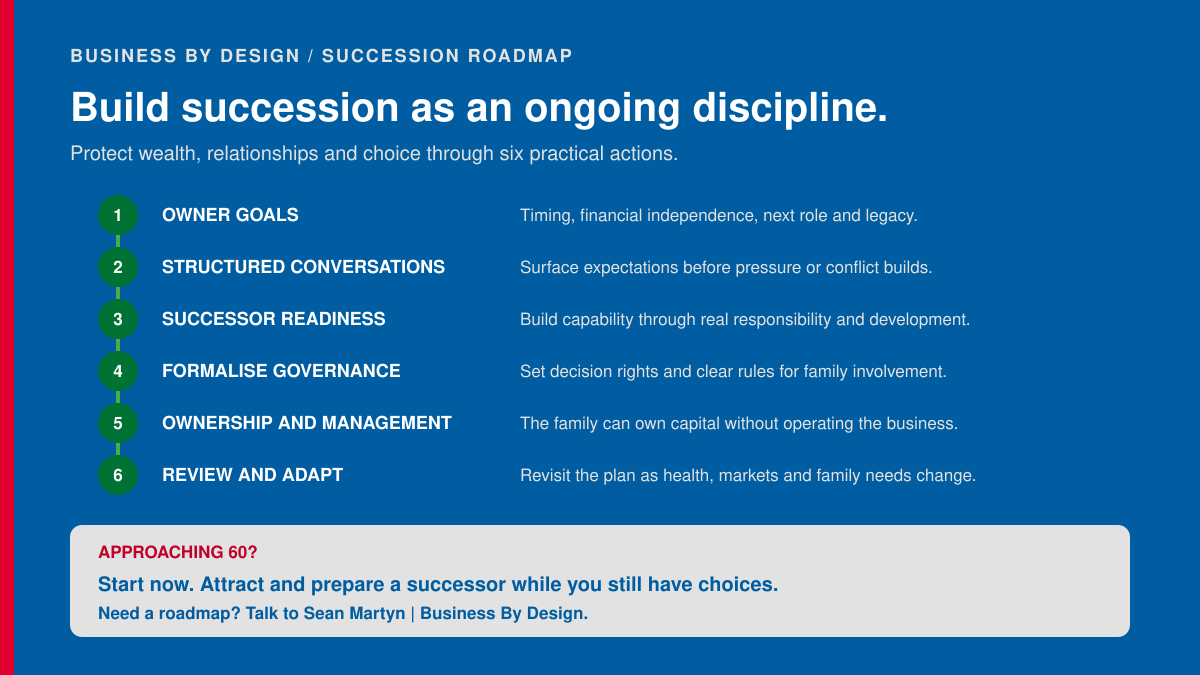
First, clarify what the owner needs financially and personally. When do you want to step back? How much wealth do you need outside the business? What role do you want afterwards? What does a successful legacy look like?
Then create structured conversations where expectations can be raised before pressure builds. Define decision rights and rules for family involvement. Assess successor readiness rather than assuming it. Potential leaders need real responsibility, development and the chance to make decisions while support is still available.
Also separate ownership from management. The next generation may want to retain ownership without running daily operations. A professional manager or sale may protect capital and relationships better than forcing a family member into the wrong role.
If you’re nearing 60, use the window you have
Succession planning is not only for ageing founders. But if you are approaching 60, time to prepare a successor and choose your next role is precious. In a few short years, health, fatigue, conflict or market changes may force decisions before the business is ready.
Age 60 is not a legal cut-off. It is a practical warning to act while you still have choices. Attract and develop a successor now. Test their capability, share responsibility in stages and review the plan as health, markets and family needs change. Work through your ownership and exit options before a crisis narrows them.
Sean and Business By Design can help
We see succession challenges across our clients and other businesses. Sean Martyn has helped many businesses plan for succession and is currently supporting several clients through the process.
At Kelly Grains, succession planning and implementation took 22 months. The work included preparing the next CEO, clarifying responsibilities and supporting the outgoing leader’s move into a mentoring role. The case study reports that the profit and loss remained positive during the transition, with no significant operational change noticed by customers and suppliers.
Business By Design can help owners and leadership teams clarify goals, assess successor readiness, define roles and decision-making, and turn the transition into a staged roadmap. Sean can also work alongside your accountant, lawyer and other advisers on the specialist financial, tax and legal matters.
Succession success is not measured by whether a family member becomes CEO. It is measured by whether the business, its wealth and its relationships are ready for what comes next. If you’re nearing 60, start attracting and preparing a successor now. Need a roadmap? Contact Sean and Business By Design while you still have options.